

40 Aesthetic Japanese Words With Deep Meanings
Last Updated on 05/09/2026 by Mayi
Some Japanese words carry an entire scene, emotion or philosophy inside a few characters. Aesthetic Japanese words are terms that name a feeling, a moment or a way of seeing that English has no single word for — like komorebi, sunlight filtering through leaves, or wabi-sabi, the beauty of things that are worn and imperfect.
I’m not sure exactly when my love for the Japanese language began. It grew alongside my fascination with Japan itself: the quiet gardens, the changing seasons, the thoughtful customs, and the habit of finding beauty in the smallest everyday moments.
Nearly every word below was explained to me by a Japanese friend or teacher, usually in the middle of something ordinary — buying cracked teacups in a Kyoto flea market, walking a ginkgo-lined path in Nikko in autumn, watching a friend lose an argument with a Paris patisserie window. That’s the part a dictionary can’t give you, so it’s the part I’ve kept.
Below are 40 of my favourite meaningful and aesthetic Japanese words, grouped into aesthetic concepts, nature, the seasons, life and emotion, everyday expressions, untranslatable words and onomatopoeia. Each one comes with the kanji, the kana, a syllable-by-syllable pronunciation and how it’s really used rather than how it looks on a poster.
If you’re preparing for a first visit, start with my complete guide to planning a trip to Japan, and bookmark these useful Japanese phrases for travellers.
All 40 aesthetic Japanese words at a glance
Tap any word to jump straight to it.
| Word (how to say it) | Kanji / kana | What it means |
|---|---|---|
| Wabi-sabi wa-bi-sa-bi | 侘寂 · わびさび | Beauty in what is imperfect, worn and impermanent |
| Kintsugi kin-tsu-gi | 金継ぎ · きんつぎ | Repairing broken pottery with gold so the breaks show |
| Kanso kan-so | 簡素 · かんそ | Simplicity reached by taking things away |
| Shibui shi-bu-i | 渋い · しぶい | Quiet, understated beauty that grows on you |
| Yūgen yuu-gen | 幽玄 · ゆうげん | Profound beauty that is felt rather than seen |
| Ma ma | 間 · ま | The meaningful space or pause between things |
| Mono no aware mo-no-no-a-wa-re | 物の哀れ · もののあわれ | The tender sadness of knowing beauty will pass |
| Ichi-go ichi-e i-chi-go i-chi-e | 一期一会 · いちごいちえ | “One time, one meeting” — this moment won’t repeat |
| Komorebi ko-mo-re-bi | 木漏れ日 · こもれび | Sunlight leaking through the leaves of trees |
| Shinrin-yoku shin-rin-yo-ku | 森林浴 · しんりんよく | “Forest bathing” — being among trees for your health |
| Satoyama sa-to-ya-ma | 里山 · さとやま | The lived-in landscape where village meets mountain |
| Sakura sa-ku-ra | 桜 · さくら | Cherry blossom |
| Hanami ha-na-mi | 花見 · はなみ | Gathering under the blossom to look at it |
| Hanafubuki ha-na-fu-bu-ki | 花吹雪 · はなふぶき | “Flower blizzard” — petals falling like snow |
| Tsuyu tsu-yu | 梅雨 · つゆ | The plum rains — Japan’s rainy season |
| Kōyō kou-you | 紅葉 · こうよう | Autumn leaves turning colour |
| Momijigari mo-mi-ji-ga-ri | 紅葉狩り · もみじがり | “Hunting” autumn leaves — travelling to see them |
| Kogarashi ko-ga-ra-shi | 木枯らし · こがらし | The first cold wind that announces winter |
| Yukigeshō yu-ki-ge-shou | 雪化粧 · ゆきげしょう | “Snow makeup” — a landscape dusted white |
| Ikigai i-ki-ga-i | 生きがい · いきがい | Your reason for getting up in the morning |
| Ganbatte gan-ba-tte | 頑張って · がんばって | Do your best; hang in there; don’t give up |
| Nana korobi ya oki na-na-ko-ro-bi ya-o-ki | 七転び八起き | Fall down seven times, get up eight |
| Shōganai shou-ga-na-i | しょうがない | It can’t be helped — so let it go |
| Natsukashii na-tsu-ka-shi-i | 懐かしい · なつかしい | The warmth of a memory surfacing |
| Omotenashi o-mo-te-na-shi | おもてなし | Hospitality given without expecting anything back |
| Itadakimasu i-ta-da-ki-ma-su | いただきます | “I humbly receive” — said before eating |
| Gochisōsama deshita go-chi-sou-sa-ma | ごちそうさまでした | “Thank you for the feast” — said after eating |
| Otsukaresama o-tsu-ka-re-sa-ma | お疲れ様 · おつかれさま | “You must be tired” — thanks for your hard work |
| Ojama shimasu o-ja-ma-shi-ma-su | お邪魔します | “Excuse me for intruding” — on entering a home |
| Sumimasen su-mi-ma-sen | すみません | Excuse me, sorry, and thank you — all at once |
| Kuchisabishii ku-chi-sa-bi-shi-i | 口寂しい · くちさびしい | “Lonely mouth” — eating because you’re bored |
| Kuidaore ku-i-da-o-re | 食い倒れ · くいだおれ | To eat yourself into ruin |
| Irusu i-ru-su | 居留守 · いるす | Pretending you’re not home |
| Tsundoku tsun-do-ku | 積ん読 · つんどく | Buying books and letting them pile up unread |
| Yoko-meshi yo-ko-me-shi | 横飯 · よこめし | The stress of speaking a foreign language |
| Doki doki do-ki-do-ki | どきどき · ドキドキ | The thump of a racing heart |
| Kasakasa ka-sa-ka-sa | かさかさ · カサカサ | The dry rustle of leaves or paper |
| Pika pika pi-ka-pi-ka | ぴかぴか | Sparkling, gleaming, spotlessly clean |
| Fuwafuwa fu-wa-fu-wa | ふわふわ | Soft, light and fluffy |
| Wakuwaku wa-ku-wa-ku | わくわく | Fizzing with happy anticipation |
Beautiful Japanese words and aesthetic concepts
Japanese aesthetics get summarised online as “simplicity, nature and impermanence”, which is true and almost useless. Wabi-sabi, yūgen and mono no aware are not design rules. They are eight different ways of noticing beauty, and they overlap without being interchangeable.
1. Wabi-sabi (侘寂 · わびさび)
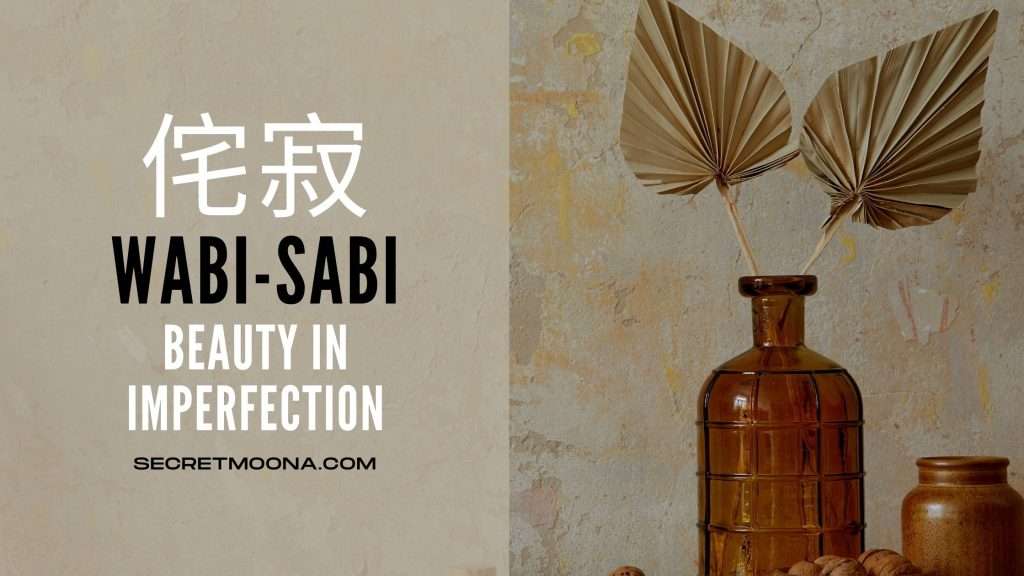
Wabi-sabi (wa-bi-sa-bi) is the appreciation of beauty that is imperfect, impermanent and incomplete — a chipped bowl, a faded wall, a garden left slightly wild. You’ll also see it written 侘び寂び, with the okurigana spelled out.
The two ideas developed separately. 侘 (wabi) came to suggest an understated beauty found in simplicity and restraint. 寂 (sabi) is the quiet character that objects acquire through age and use. Together they describe a sensitivity to weathered surfaces, asymmetry, natural materials and the passage of time.
I first met the idea in a Kyoto flea market, buying a set of teacups. One cup was uneven and visibly marked by its history, and the seller charged more for it, not less. It took me a while to understand that wasn’t a joke at my expense.
Wabi-sabi is not an interior-design trend, whatever the furniture catalogues say. It’s a reminder that age, change and imperfection don’t automatically diminish something’s value. In Zen it is usually described through seven qualities set out by the philosopher Hisamatsu Shin’ichi:
- Kanso (簡素) — simplicity
- Fukinsei (不均斉) — asymmetry, irregularity
- Shizen (自然) — naturalness, without pretension
- Yūgen (幽玄) — subtle grace; what is suggested rather than shown
- Datsuzoku (脱俗) — freedom from convention
- Seijaku (静寂) — stillness, tranquillity
- Kokō (枯高) — weathered austerity. You’ll often see this written 考古 online, which means “archaeology” and is simply a typo that has been copied from site to site.
2. Kintsugi (金継ぎ · きんつぎ)
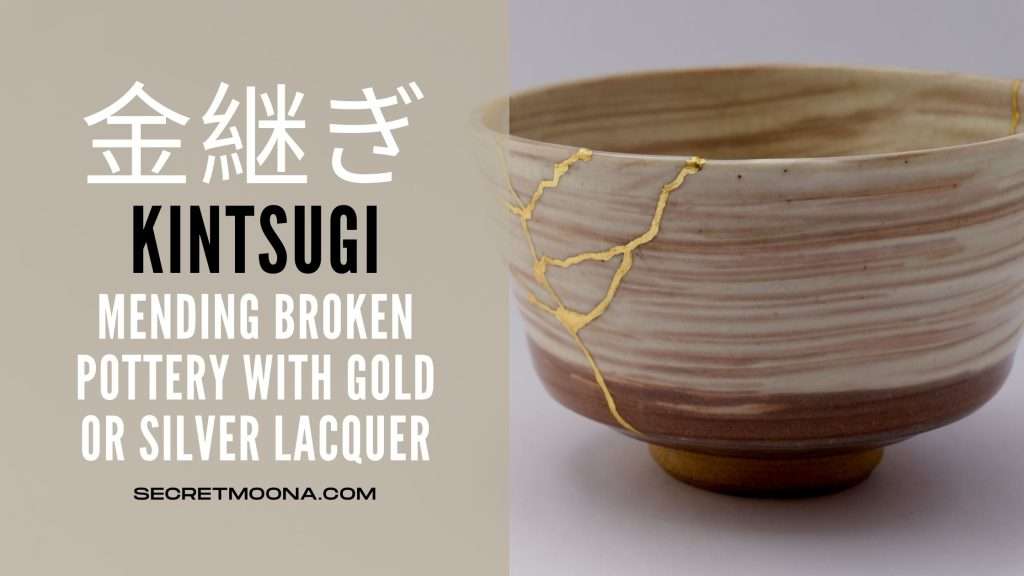
Kintsugi (kin-tsu-gi) is the technique of repairing broken pottery with lacquer, finished with powdered gold or silver, so that the repair is the most visible part of the object. Literally “golden joinery”; also called kintsukuroi (金繕い), “golden mending”.
Rather than disguising the cracks, the repair makes them part of the object’s story. A broken bowl does not return to its original state — it becomes something else, with its damage and its mending on show.
Kintsugi and wabi-sabi are constantly used as synonyms online, and they aren’t. Wabi-sabi is a broad aesthetic sensibility; kintsugi is one specific repair technique that happens to express it. Proper kintsugi with urushi lacquer also takes weeks of drying between layers, which is worth knowing before you buy a “kintsugi kit” that promises an afternoon.
3. Kanso (簡素 · かんそ)
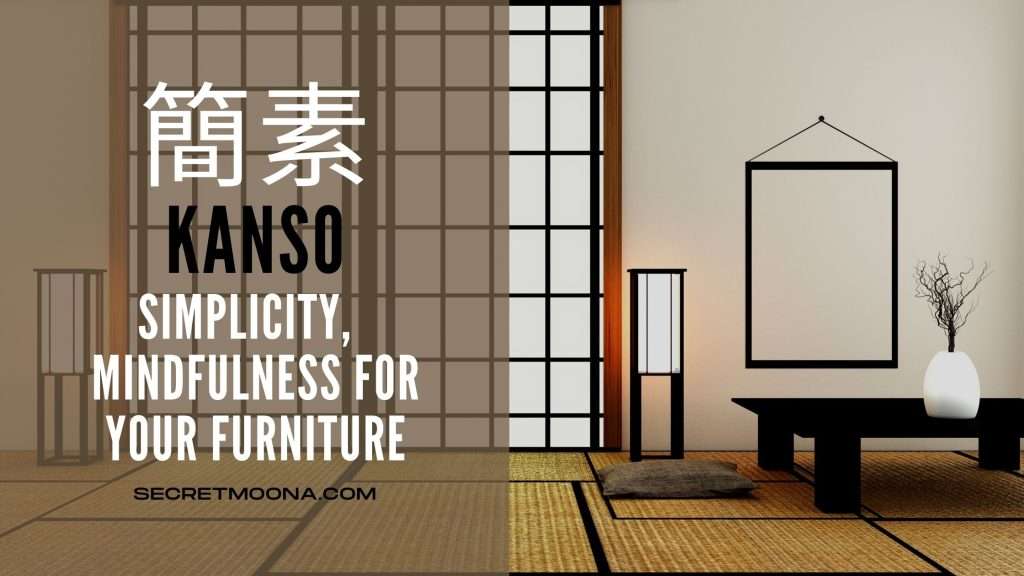
Kanso (kan-so) is simplicity, plainness, the absence of unnecessary decoration — beauty reached by removing things rather than adding them.
The idea is that clearing away excess lets the essential character of an object or a space come forward. You can see it in the restraint of tea rooms, in Japanese garden design, and in everyday objects made from plain natural materials.
Kanso doesn’t mean owning as little as possible. It’s about clarity and giving each thing room to breathe. If you’ve watched Marie Kondo empty a wardrobe onto a bed, you’ve watched a very cheerful version of it.
4. Shibui (渋い · しぶい)

Shibui (shi-bu-i) is a subtle, understated beauty that reveals more the longer you look at it. A muted ceramic bowl, an indigo textile, a wooden building that has aged well.
The word originally meant “astringent” — the pucker of an unripe persimmon — and it kept that edge. Shibui things are never sweet or showy. They don’t ask for attention, and they don’t tire you out.
In modern Japanese it’s also a compliment you can pay a person, roughly “quietly cool” — and, confusingly, a way of saying someone is being a bit stingy. Context does the work.
5. Yūgen (幽玄 · ゆうげん)

Yūgen (yuu-gen) is a profound, mysterious beauty that is felt rather than explained — the suggestion of something vast just beyond what you can see. 幽 is “dim” or “hidden”; 玄 is “profound”.
Classical descriptions reach for images instead of definitions: mountains disappearing into mist, the moon half hidden by cloud, geese vanishing behind a distant ridge, a path that continues past your line of sight. Zeami, who shaped Noh theatre in the fourteenth century, made it his central principle.
Yūgen leaves room for the imagination, and its beauty lies partly in what stays concealed. If wabi-sabi is beauty in what is worn, yūgen is beauty in what is withheld.
6. Ma (間 · ま)

Ma (ma) is the space, pause or interval between things — and it is treated as something, not nothing.
It’s the silence between musical notes, the empty floor in a room, the beat before someone answers you, the distance between two rocks in a garden. That space is what gives shape and meaning to everything around it.
The kanji 間 is a sun (日) seen through a gate (門) — light in a gap. Once you start noticing ma you see it everywhere in Japan: in architecture, in flower arranging, in the unhurried rhythm of a conversation that a British speaker would have rushed to fill.
7. Mono no aware (物の哀れ · もののあわれ)
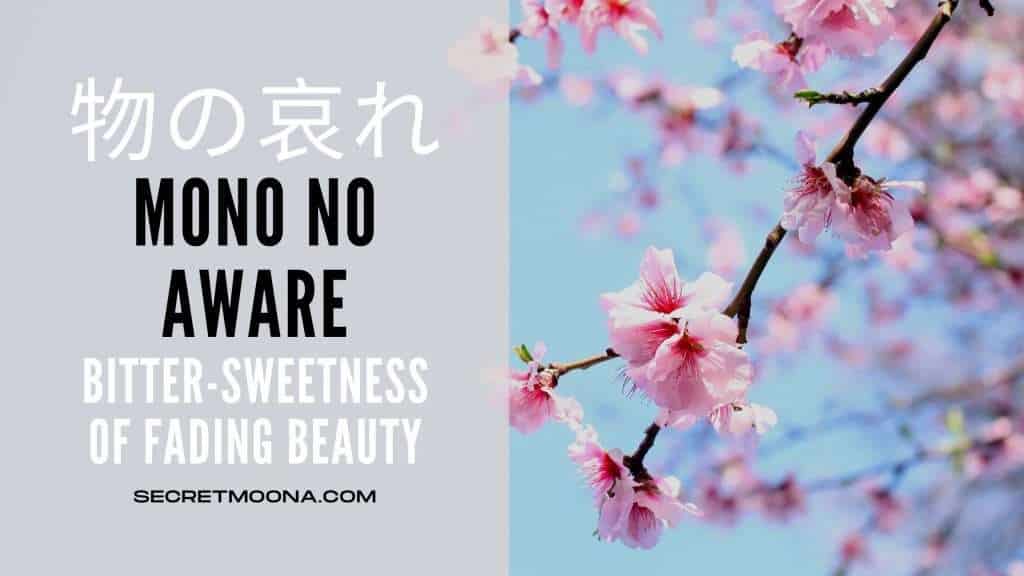
Mono no aware (mo-no-no-a-wa-re) is an awareness of how temporary things are, and the gentle ache that comes with it. Often translated as “the pathos of things”.
Cherry blossom is the standard illustration. Sakura are loved partly because they last about a week. Crowds sit beneath them knowing the petals will be on the pavement by the following weekend, and that knowledge isn’t a flaw in the experience — it is the experience.
It isn’t simply sadness. It combines melancholy with gratitude for a moment you know is going. Autumn does it too, which is one reason Japan in autumn is such an emotional trip. The scholar Motoori Norinaga used the term to explain what makes The Tale of Genji so affecting.
8. Ichi-go ichi-e (一期一会 · いちごいちえ)

Ichi-go ichi-e (i-chi-go i-chi-e) means “one time, one meeting”: every encounter is unique and will never happen in exactly this form again.
It comes out of the tea ceremony, where the host prepares as though this gathering will never be repeated — because it won’t. Even meeting the same person in the same room, the season, the light and both of you will have moved on.
It’s a quiet instruction to pay attention to whoever is in front of you, and it underpins omotenashi further down this list.
Japanese words for nature
Japan’s close attention to the natural world runs right through its language. These three name forests, landscapes and small details that most languages notice but never bother to label.
9. Komorebi (木漏れ日 · こもれび)
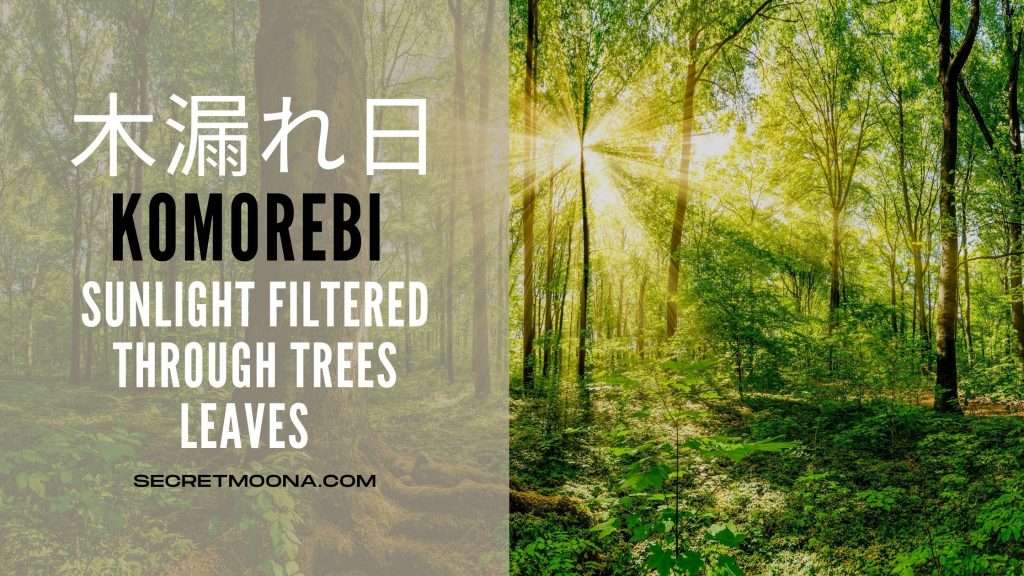
Komorebi (ko-mo-re-bi) is sunlight leaking through the leaves of trees — the shifting pattern of light and shadow it throws on a path, on the grass, or across a curtain.
The kanji are almost a diagram of the thing itself: 木 tree, 漏れ leaking, 日 sun. English needs a whole sentence and still doesn’t quite land it.
It’s the most requested word on this list, and I understand why — once you have a name for it you notice it constantly, in a temple garden, on a wooded pilgrimage trail, or in an ordinary park at home. The quieter landscapes of Shikoku are full of it.
10. Shinrin-yoku (森林浴 · しんりんよく)
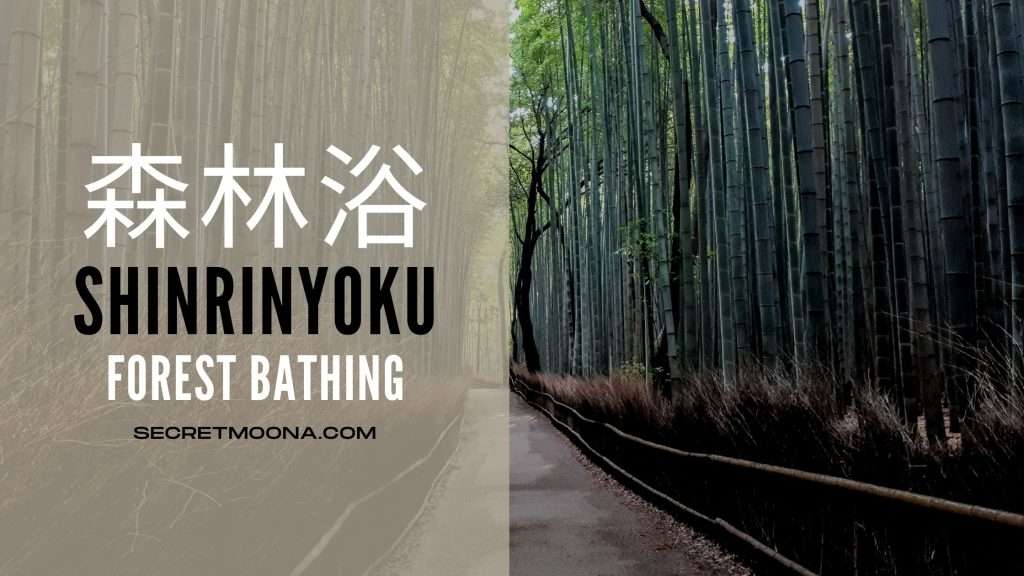
Shinrin-yoku (shin-rin-yo-ku) literally means “forest bathing”: spending unhurried time among trees and taking the forest in through your senses — its scent, the birds, the light.
No water is involved, and no difficult hike either. 森 (mori) is forest, 林 (hayashi) is woodland, 浴 is bathing. The term is younger than most words here — coined by Japan’s Forestry Agency in 1982 as a public health measure, and studied since for its effects on stress and blood pressure.
What I like is how undemanding it is. A big park with old trees will do. For the full version, the cedar forests around Nikko and the Japanese countryside generally are where it makes most sense.
11. Satoyama (里山 · さとやま)

Satoyama (sa-to-ya-ma) is the landscape where village and mountain meet — rice paddies, ponds, coppiced woodland and houses forming one connected environment.
里 is a village or hamlet; 山 is a mountain. Crucially, satoyama is not wilderness. It’s land shaped over centuries by people working with it, and its biodiversity depends on that continued use — which is why abandoned satoyama becomes a conservation problem rather than a return to nature.
It’s the single best argument for looking past Tokyo and Kyoto. My guide to visiting the Japanese countryside covers why these quieter areas so often turn out to be the most memorable part of a trip.
Japanese words for the seasons
The seasons are visible in Japanese food, festivals, poetry and travel planning in a way they aren’t in Britain. Traditionally the year is divided not into four seasons but into twenty-four sekki and seventy-two kō — micro-seasons a few days long, with names like “rotten grass becomes fireflies”. These eight words are the ones you’ll actually meet.
12. Sakura (桜 · さくら)

Sakura (sa-ku-ra) is cherry blossom — and, by extension, the whole national mood that arrives with it.
The blossom opens for roughly a week in any one place, moving north across the country as the weather warms. The forecast front is tracked on the news like a weather system, and popular viewing spots get genuinely crowded.
Sakura are not simply pretty flowers. Their brevity is the point, which makes them the clearest possible expression of mono no aware.
13. Hanami (花見 · はなみ)

Hanami (ha-na-mi) means “flower viewing” — going out specifically to sit under the blossom and look at it.
花 is flower, 見 is looking. Friends, families and entire offices lay out sheets beneath the trees for picnics, seasonal food and a good deal of drinking. Junior colleagues are traditionally sent ahead in the morning to hold the spot.
Famous parks become loud and joyful; temple grounds and small neighbourhood canals give you the quieter version. Both are worth doing.
14. Hanafubuki (花吹雪 · はなふぶき)

Hanafubuki (ha-na-fu-bu-ki) is a “flower blizzard” — the moment thousands of cherry petals come off the trees at once and swirl through the air like snow.
花 flower, 吹雪 snowstorm. It marks the end of the blossom, and it is frequently more beautiful than the blossom at its peak.
That a culture built a dedicated word for the falling rather than the flowering tells you most of what you need to know about Japanese aesthetics.
15. Tsuyu (梅雨 · つゆ)

Tsuyu (tsu-yu) is Japan’s rainy season, falling between spring and summer — roughly June into mid-July, though the timing shifts by region and Hokkaido largely escapes it.
The kanji are “plum” and “rain”: 梅雨, the plum rains, named for the period when Japanese plums ripen. The same characters can also be read baiu.
Everyone will tell you to avoid it. I’d gently disagree — tsuyu brings hydrangeas, saturated green moss, empty gardens and the particular smell of wet stone at a temple. Bring a decent umbrella and go anyway.
16. Kōyō (紅葉 · こうよう)

Kōyō (kou-you) is the turning of the leaves in autumn — the phenomenon itself, tracked by forecast just as the blossom is in spring.
Here’s the detail that trips people up: the same two characters 紅葉 are also read momiji, meaning maple leaves. Same kanji, two readings, two slightly different meanings. Context tells you which.
The colour arrives first in Hokkaido and the mountains and works its way south, so the season stretches from September to early December depending where you are. Tokyo’s gardens are usually at their best in late November.
17. Momijigari (紅葉狩り · もみじがり)

Momijigari (mo-mi-ji-ga-ri) is going out to admire the autumn leaves — the autumn counterpart to hanami.
狩り (gari) means hunting, so the word literally reads “red-leaf hunting”, but nothing is picked or taken. The hunting is done entirely with your eyes, which I find a rather lovely piece of linguistic manners.
It’s an excuse to travel to a garden, temple or mountain valley purely to look at trees. For inspiration, see my collection of beautiful Japanese gardens around the world and why autumn is the best time to visit Japan.
18. Kogarashi (木枯らし · こがらし)

Kogarashi (ko-ga-ra-shi) is the cold, dry wind that announces winter — specifically the first strong northerly of the season.
木枯らし means, roughly, “the wind that withers the trees”. It isn’t a general word for wind. It carries the feeling of autumn closing down and the cold arriving, and it is announced on the news as kogarashi ichigō — “kogarashi number one”, the first of the year.
A country that dates the arrival of winter by naming a particular wind is a country that is paying attention.
19. Yukigeshō (雪化粧 · ゆきげしょう)

Yukigeshō (yu-ki-ge-shou) literally means “snow makeup”: a landscape lightly dusted with snow, as though it has been made up rather than buried.
雪 is snow and 化粧 is makeup or cosmetics — the same word used for a face. It’s reserved for that first thin, flattering layer on mountains, rooftops, pines and temple roofs, not for a metre of the stuff.
It pairs neatly with kogarashi: one word for the wind that ends autumn, one for the snow that quietly redecorates afterwards.
Meaningful Japanese words about life and emotion
These five describe attitudes towards purpose, effort, acceptance and memory. They’re the words most often quoted in English, and most often flattened in translation.
20. Ikigai (生きがい · いきがい)

Ikigai (i-ki-ga-i) is your reason for getting up in the morning — something that makes life feel worth living. 生き is “living”; かい is “worth” or “benefit”.
You’ve almost certainly seen the four-circle diagram: what you love, what you’re good at, what the world needs, what you can be paid for. That diagram is a modern Western interpretation layered on afterwards, not a definition of the Japanese word — and the “what you can be paid for” circle is the part that isn’t there in Japanese at all.
In Japan an ikigai is usually much smaller and more ordinary: a grandchild, a garden, a shop you open every morning, a Tuesday choir. It doesn’t have to be your career and it certainly doesn’t have to pay. Mine is writing about travel, culture and language, which is roughly how this post exists.
21. Ganbatte (頑張って · がんばって)

Ganbatte (gan-ba-tte) means “do your best”, “keep going”, “hang in there”. It’s usually translated as “good luck”, which is misleading — luck has nothing to do with it. You are being told to persist.
You’ll hear it before exams and interviews, at the start of a shift, and shouted from the side of every road race in the country. Ganbarimasu (“I’ll do my best”) is what you say back; ganbare is the blunter, more shouted version.
22. Nana korobi ya oki (七転び八起き)

Nana korobi ya oki (na-na-ko-ro-bi ya-o-ki) means “fall down seven times, get up eight”. Difficulty is assumed; standing back up is the part you’re responsible for.
The extra rise is not a counting error. You start the count on the floor, so eight recoveries follow seven falls — and the proverb is deliberately weighted so that getting up always outnumbers going down.
It’s the idea behind daruma dolls, those round red figures weighted at the base so they right themselves however hard you push them over.
23. Shōganai (しょうがない)
Shōganai (shou-ga-na-i) means “it can’t be helped”. You say it about the things you genuinely cannot change, and then you stop carrying them.
It’s a contraction of しようがない (shiyou ga nai), “there is no way of doing”. The more formal equivalent is 仕方がない (shikata ga nai). Depending on tone it can sound calm, practical, disappointed or flatly resigned.
Outsiders sometimes read it as fatalism. It isn’t, quite — it’s recognising what can’t be changed so you can stop dwelling on it. Having watched it deployed over a cancelled train, a typhoon and a lost booking, I’d say it’s considerably healthier than the British alternative of complaining for an hour.
24. Natsukashii (懐かしい · なつかしい)

Natsukashii (na-tsu-ka-shi-i) is the warm rush that arrives when something brings back a fond memory — an old song, a smell, a childhood snack, a street you haven’t walked down in years.
It’s usually translated as “nostalgic”, and that’s the trap. English nostalgia leans wistful and a little sad. Natsukashii is almost entirely happy — an affectionate recognition, said out loud and often with a laugh.
Where an English speaker would say “oh, that takes me back”, a Japanese speaker just says natsukashii, and it functions as a complete sentence.
Useful everyday Japanese expressions
These six are the ones I’d actually learn before a trip. They aren’t poetic — they’re the small verbal courtesies that structure a Japanese day, and using them correctly changes how a room responds to you. For the full practical set, see my guide to 30+ Japanese phrases for first-time travellers.
25. Omotenashi (おもてなし)
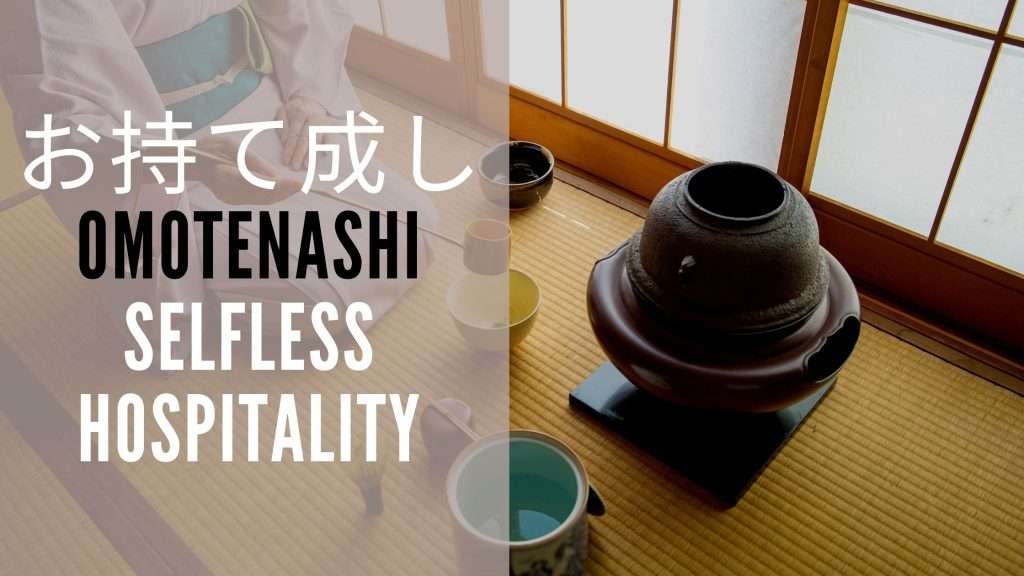
Omotenashi (o-mo-te-na-shi) is hospitality offered sincerely, without expectation of return, and without the guest having to ask. Occasionally written with the ateji 御持て成し, but おもてなし is what you’ll see.
It is not the same as good service. Service is a transaction with a tip at the end. Omotenashi is anticipating what someone needs before they know they need it, and then not drawing attention to having done it — the taxi door that opens itself, the shop assistant who walks you to the corner rather than pointing.
It grows directly out of ichi-go ichi-e. You’ll feel it most in a ryokan or a tea ceremony, and it explains a good deal of the etiquette that surprises first-time visitors.
26. Itadakimasu (いただきます)
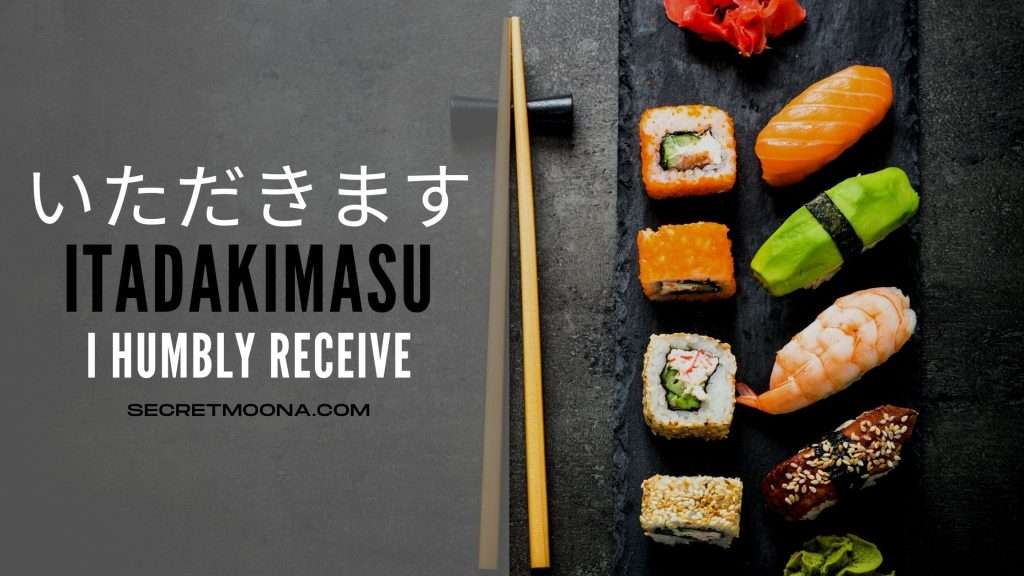
Itadakimasu (i-ta-da-ki-ma-su) is said immediately before eating. It’s usually glossed as “bon appétit”, but it literally means “I humbly receive”.
The thanks aren’t aimed only at the cook. They extend to the farmer, the fisherman, the driver — and to the plant or animal itself. It’s closer to grace than to a toast, which is why it’s said quietly, hands together, even when eating alone.
Say it before your first bite of anything, convenience-store onigiri included. Nobody will find it odd. If you’re arriving hungry, my list of must-eat Japanese food is where to point that gratitude.
27. Gochisōsama deshita (ごちそうさまでした)
Gochisōsama deshita (go-chi-sou-sa-ma de-shi-ta) is the bookend to itadakimasu: “thank you for the feast”, said when you finish.
馳走 (chisō) originally meant running around — the effort of gathering ingredients and preparing a meal for someone. So you are thanking the host for the trouble they went to, not just for the food.
Say it to your host at home, and to the chef on your way out of a small restaurant. In a ramen counter with six seats it’s very close to obligatory, and it will be answered.
28. Otsukaresama (お疲れ様 · おつかれさま)
Otsukaresama (o-tsu-ka-re-sa-ma) acknowledges that someone has worked hard. It literally means “you are honourably tired”, which is a translation that tells you almost nothing about how it’s used.
In practice it does the work of hello, goodbye, well done and thank you, all at once. Colleagues say it to each other leaving the office. Friends use the casual otsukare when meeting after work. The full otsukaresama deshita is the polite past tense for a finished job.
It’s my favourite word here. My Japanese teacher — now a good friend — would open with “otsukare” every time we met in the evening, and after a long day it functioned as permission to stop trying so hard.
29. Ojama shimasu (お邪魔します)

Ojama shimasu (o-ja-ma-shi-ma-su) is said as you step into someone’s home. It means “I’m going to intrude” — so it is closer to “excuse me for disturbing you” than to “thank you for having me”, which is how it’s often mistranslated.
邪魔 (jama) means hindrance or nuisance, so you are politely casting yourself as an inconvenience. It’s the same instinct as taking your shoes off at the genkan: you are entering someone’s space and marking that you know it.
On the way out you switch to the past tense — お邪魔しました (ojama shimashita). It works beyond doorways too, for interrupting a conversation or stepping into a meeting.
30. Sumimasen (すみません)

Sumimasen (su-mi-ma-sen) means “excuse me”, “I’m sorry” and sometimes “thank you”, depending entirely on the situation. If you learn one word before flying, learn this one.
Use it to get a waiter’s attention, to apologise for squeezing past someone on a train, or to thank somebody who has gone out of their way for you. That last use is the interesting one: it carries a trace of “I’m sorry you went to that trouble on my account”, which is a very Japanese way to say thank you.
In casual speech it often contracts to suimasen. Both are fine; nobody is marking you.
Unusual and difficult-to-translate Japanese words
Not every Japanese word carries a philosophy. These five are memorable because they name extremely specific — and very relatable — situations that English somehow never bothered to label.
31. Kuchisabishii (口寂しい · くちさびしい)
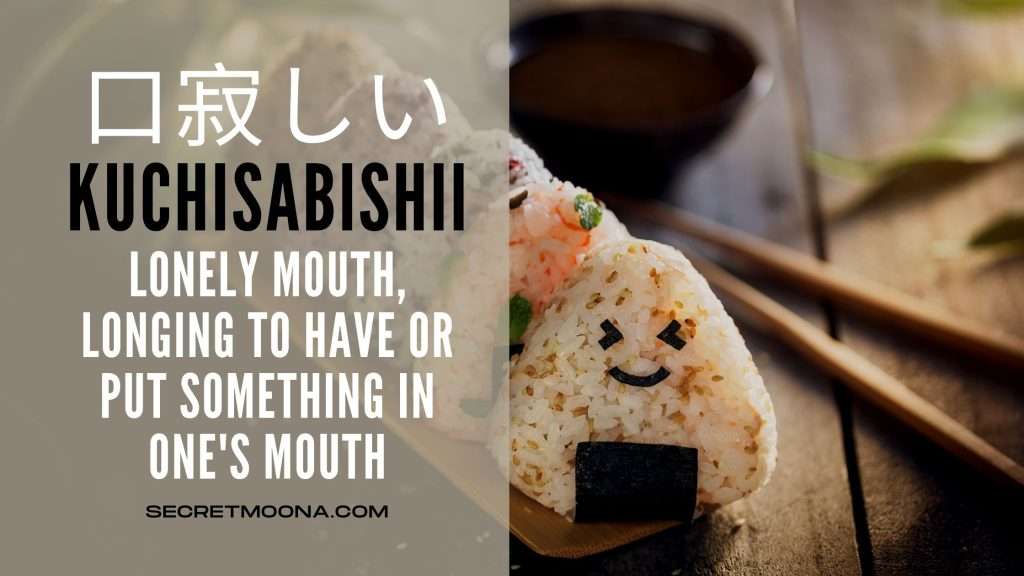
Kuchisabishii (ku-chi-sa-bi-shi-i) means “lonely mouth”: eating not because you’re hungry but because your mouth has nothing to do. Boredom snacking, essentially.
口 is mouth and 寂しい is lonely — the same 寂 as in wabi-sabi, wearing a very different hat. English can describe the behaviour but has no word that locates it in the mouth rather than the stomach.
A Japanese friend taught me this one while visiting me in Paris, standing in front of a patisserie window and losing an argument with herself. It’s also the standard excuse for reaching for a cigarette.
32. Kuidaore (食い倒れ · くいだおれ)
Kuidaore (ku-i-da-o-re) means to eat yourself into ruin — to love food and drink so much that you’ll happily spend everything you have on it. 食い is eating; 倒れ is collapsing or falling over.
The word belongs to Osaka, and specifically to Dōtonbori, where the restaurants, stalls and neon run for street after street. Osaka’s nickname is tenka no daidokoro, “the nation’s kitchen”, and kuidaore is what the city does to visitors.
As someone who plans a large part of a trip around food, I take this as a warning I have never once heeded. If you want to plan your own ruin properly, start with 40 must-eat Japanese dishes.
33. Irusu (居留守 · いるす)
Irusu (i-ru-su) is pretending you’re not at home when someone knocks. There is a word for it, which means enough people do it to have needed one.
The kanji make the joke themselves: 居 means “to be present” and 留守 means “to be out”. Being in, while being out.
A wonderfully specific word for those moments when you clock someone at the door and decide to stay very still until they leave.
34. Tsundoku (積ん読 · つんどく)

Tsundoku (tsun-do-ku) is buying books and letting them pile up unread. Not hoarding — the intention to read them is completely sincere. It just never quite happens.
The word is a pun, and a good one. 積んでおく (tsunde oku) means “to pile up and leave for later”; 読 (doku) means reading. Squash them together and you get 積ん読. It dates to the Meiji era, so the habit comfortably predates online bookshops making it frictionless.
I am guilty on a scale I would rather not quantify.
35. Yoko-meshi (横飯 · よこめし)
Yoko-meshi (yo-ko-me-shi) is the particular strain of speaking a foreign language — the effort of making yourself understood, and the low anxiety of not being sure you have.
It means “a meal eaten sideways”: 飯 (meshi) is cooked rice or, by extension, a meal, and 横 (yoko) is horizontal. Japanese is traditionally written vertically; European languages run sideways. Eating sideways is doing something ordinary in an awkward, foreign orientation.
As someone who lives and writes in more than one language, this is the word on the list I have felt most often — and the reason I put pronunciation guides in this post.
Japanese onomatopoeia
Japanese has thousands of sound-symbolic words, and unusually, they cover far more than sound. Giseigo imitate living things, giongo imitate objects, and gitaigo describe states that make no noise at all — the way something glitters, or the way a mood settles. These five are my favourites.
36. Doki doki (どきどき · ドキドキ)

Doki doki (do-ki-do-ki) is the thump of a fast heartbeat — and, at the same time, the feeling that causes it: excitement, nerves, a crush, dread.
That double duty is what makes it interesting. It’s both giseigo (the sound a living body makes) and gitaigo (the emotional state), which is why one word covers six flights of stairs and a first date.
The rhythm does the work: dokidokidokidoki when your pulse is up, a slow doki… doki… doki… when it isn’t.
37. Kasakasa (かさかさ · カサカサ)

Kasakasa (ka-sa-ka-sa) is the dry rustle of one dry thing against another — leaves underfoot, paper, a plastic bag. It also describes dry skin, which is the version you’ll find on hand-cream packaging.
I learned it in Nikko on an autumn afternoon, walking a path buried in fallen ginkgo leaves with Japanese friends. One of them told me the noise we were making was kasakasa, and I’ve never been able to walk through dry leaves since without hearing it.
Written in hiragana it feels soft; in katakana, カサカサ, it feels sharper and drier. Japanese lets you choose.
38. Pika pika (ぴかぴか)

Pika pika (pi-ka-pi-ka) describes something sparkling, gleaming or spotlessly clean — polished shoes, a scrubbed kitchen, lights flashing, or something brand new.
It’s gitaigo: nothing makes a “pika” noise. The word describes how light behaves, not a sound at all.
And yes — this is where Pikachu gets the first half of his name, with chū, the Japanese noise for a mouse squeaking, supplying the rest.
39. Fuwafuwa (ふわふわ)

Fuwafuwa (fu-wa-fu-wa) is soft, light and fluffy — clouds, blankets, a cat’s stomach, a soufflé pancake.
It also covers floating gently through the air, and by extension a head that isn’t quite attached to its body: feeling fuwafuwa can mean light-headed, or pleasantly unfocused.
You’ll meet it constantly on menus and packaging, where it does the work of “fluffy” and “melt-in-the-mouth” at once.
40. Wakuwaku (わくわく)

Wakuwaku (wa-ku-wa-ku) is cheerful excitement and anticipation — the fizz before a long-awaited trip, an unopened present, a first look at somewhere new.
The verb 湧く (waku) means to well up or bubble out, like water from a spring. That’s exactly the sensation.
Where doki doki can carry anxiety, wakuwaku is purely happy — which makes it a good word to end forty on.
Frequently asked questions
What is the most beautiful Japanese word?
There is no single answer, but komorebi (木漏れ日) is the one most people choose. It means sunlight leaking through the leaves of trees, and its kanji spell out the image exactly: tree, leaking, sun. Other strong candidates are yūgen, mono no aware and hanafubuki.
What are some Japanese words for nature?
The most evocative are komorebi (sunlight through leaves), shinrin-yoku (forest bathing), satoyama (the lived-in landscape where village meets mountain) and kogarashi (the cold wind that announces winter). Each names something most languages notice but never label.
What are the Japanese words for the seasons?
Sakura and hanami belong to spring, ending in hanafubuki, the blizzard of falling petals. Tsuyu is the rainy season between spring and summer. Kōyō and momijigari cover autumn leaves, kogarashi signals winter’s arrival, and yukigeshō describes a landscape dusted with snow.
What does wabi-sabi actually mean?
Wabi-sabi (侘寂) is finding beauty in things that are imperfect, impermanent and incomplete. 侘 is the beauty of simplicity and restraint; 寂 is the quiet that things acquire through age and use. It is an aesthetic sensibility drawn from Zen Buddhism, not a decorating style, though it is frequently sold as one.
Are kintsugi and wabi-sabi the same thing?
No. Kintsugi is a specific technique for repairing broken pottery with lacquer and powdered gold. Wabi-sabi is a much broader appreciation of simplicity, age, change and imperfection. Kintsugi can express wabi-sabi, but the two terms are not interchangeable, despite being used that way online.
Which Japanese words have no English translation?
The clearest examples here are komorebi (light through leaves), tsundoku (buying books you never read), kuchisabishii (eating out of boredom), irusu (pretending you’re not home), natsukashii (the warmth of a memory surfacing) and yoko-meshi (the stress of speaking a foreign language). English can describe each, but only in a full sentence.
What is a good aesthetic Japanese word for a bio or username?
Short, soft-sounding words work best: komorebi (木漏れ日), yūgen (幽玄), kanso (簡素), ikigai (生きがい), hanafubuki (花吹雪) and seijaku (静寂, stillness). Avoid kuchisabishii and kuidaore unless you want a joke — they’re about boredom-snacking and going broke on dinner. Always check the meaning before committing one to a tattoo.
How do you pronounce Japanese words like komorebi and kuidaore?
Give every syllable equal weight and keep the vowels pure: a as in “father”, i as in “machine”, u as in “put”, e as in “bed”, o as in “or”. So ko-mo-re-bi and ku-i-da-o-re, flat and even, with no stressed syllable. A macron (yūgen, kōyō) simply means you hold that vowel twice as long.
Final thoughts on these beautiful Japanese words
What I love most about these words is the way they make you look more closely. Komorebi asks you to notice light moving through trees. Mono no aware reminds you that beauty doesn’t last. Wabi-sabi lets age and imperfection have value, and ichi-go ichi-e asks you to pay attention to an encounter that will never repeat.
The language also makes room for the far less philosophical: unread piles of books, a lonely mouth hunting for a snack, and the specific awkwardness of speaking in someone else’s language.
Once you have a name for something, you start seeing it. That’s most of what learning a language actually feels like — and it works just as well on the walk to your own local shops as it does in Kyoto.
Which Japanese word is your favourite? Let me know in the comments — I’m always collecting more.
More Japanese language and culture
- 40+ Useful Japanese Phrases for First-Time Travellers — the practical companion to this list
- 40 Must-Eat Japanese Foods — where kuidaore gets you into trouble
- Japanese Customs and Etiquette for First-Time Travellers
- Planning a Trip to Japan for the First Time
- Do You Need a Japan Rail Pass?
- Why You Should Visit the Japanese Countryside
- Things to Do in Shikoku, Beyond Japan’s Golden Route
Save this post for later on Pinterest

Photo credits: Canva & SecretMoona
Related Posts:



Haha, Irusu is totally me sometimes! What a cool list to learn about Japanese words!
Great post! It’s funny how living in Japan, some of these are used sooo much (like gambatte, dokidoki and all the aisatsu words.) Then some of the others (like the various zen words) I only heard in classes teaching about Japanese culture.
I love the concept of tsundoku, and I often see bloggers/book lovers talk about it. Although I have never heard Japanese people mention it.
I love this! I’m sure I’m butchering the pronunciation though lol. I specifically love Kintsugi. I’ve heard of filling in broken bowls and stuff with gold but I didn’t know the name for it.
Ahah! Japanese pronumciation isn’t easy… I’m glad to hear that you now now the right name 🙂
This was such an interesting read! My personal favourite is Kuidaore as I’m a foodie traveller! Thanks for sharing this!
I love that word as well. Kuidaore is exactly what I do, spend lots of money on food, especially wwhen I viist places with yummy food.
An incredibly useful post, I really enjoyed the Japanese lesson
Very useful post. It is like each word contains the soul of Japan in one or the other way.
Loved this. Perfect for my trip to Japan next spring. Thank you!
I am visiting Japan for the first time in October. I will definitely review your post to help me prepare. I already love the word for light shining through trees. Your post is illuminating.